
Texas Public Information Act
The Texas Public Information Act, in Government Code Chapter 552, sets the rule that government records are open unless a law makes them confidential. The policy statement says each person is entitled to full information about government affairs. The act gives the public the right to inspect and copy public information held by a governmental body.
Courts are treated differently. Judiciary records are a separate category under the act, so a court case file follows clerk and court rules rather than an open-records request. Anyone can make a request, and a requester does not have to explain why. See Texas Government Code Chapter 552 for the framework.
In practice, Fort Bend County records split into a few tracks. Administrative records, such as county budgets or department emails, move through the Public Information Act. Court case records run through the clerk systems. Law-enforcement records sit with the Sheriff or District Attorney. State criminal history is held by DPS. A request for a certified judgment or a divorce decree should go to the clerk, not through an open-records request, because the clerk has a copy process built for it.
What Records the County Clerk Maintains
The County Clerk is the county's recorder and holds a deep set of public records beyond the courts. Real-property and business filings start here, not at the District Clerk. The main record sets include the items below.
- Deeds, mortgages, easements, and liens in the Official Public Records.
- Assumed name certificates and DBA filings for businesses.
- Marriage licenses and vital records that occur in the county.
- Commissioners Court minutes, attachments, and videos from 1983 forward.
- Misdemeanor, county-court civil, and probate case records.
Property and vital records users should start with the County Clerk, while district court files sit with the District Clerk.
The County Clerk has made many of these records easier to reach online. It added e-commerce for Official Public Records, digitized about 2.3 million pages of older probate and civil files, and posts an online fee schedule. Even so, some legacy court documents are being moved into the Odyssey system and are withheld during that project. A record that is missing online may be in migration rather than truly gone, so it is worth asking the office.
How to File a Public Records Request in Fort Bend County
The first step is to send the request to the office that actually holds the record. Sending it to the wrong office only adds delay. Requests for District Attorney records go to the DA's Civil Division. Requests for other county department records go to the County Attorney's public information email. Arrest affidavits and police reports go to the Sheriff's Records Division. Court case copies go to the clerk.
- Identify the office that holds the record you want.
- Describe the records clearly, with names, dates, or document types.
- Submit the written request by mail, email, or the office's online channel.
- Wait for the response under the Public Information Act process.
- Pay any fees, then receive the records or a written reason for withholding.
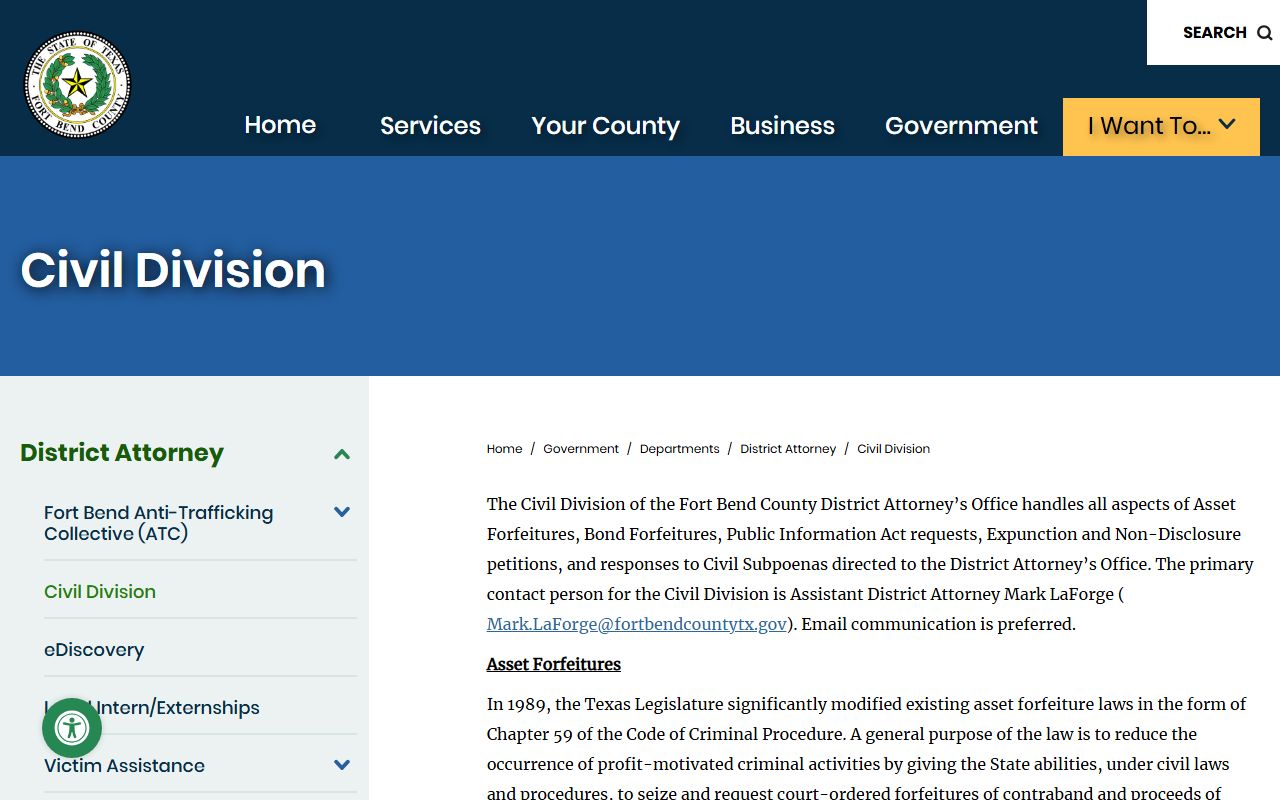
The District Attorney Civil Division handles Public Information Act requests for DA-held records.
For other county departments, the County Attorney's office takes requests at PublicInformation@fortbendcountytx.gov, and the Sheriff's Records Division uses fbcsorecords@fortbendcountytx.gov.
Matching the request to the office saves the most time. Arrest affidavits and police reports come from the Sheriff's Records Division. Asset forfeiture, bond forfeiture, and DA-held records go to the District Attorney's Civil Division. General county department records go to the County Attorney. Property, vital, and county-court records are searched directly through the County Clerk. When a request lands in the wrong inbox, the office may forward it or ask you to resend, which adds days.
A written request works best. Put the request in writing, name the records as specifically as you can, and give a date range when possible. A narrow, specific request is cheaper and faster than a broad one, because staff spend less time searching and copying.
Public Records Request Form Fields
A written request does not need a special form, but it should give the office enough to find the record. Clear details speed up the response and lower the cost. The fields below cover a typical request.
| Field | Required | Notes |
|---|---|---|
| Requester Name | Yes | Contact name and a way to reach you. |
| Description of Records | Yes | Be specific: names, document types, or case numbers. |
| Date Range | No | Narrowing dates reduces search time and fees. |
| Format Preference | No | Paper, electronic, or certified copies. |
Response Timelines
The Public Information Act expects prompt production of records. When a governmental body believes a record is confidential or excepted, it generally must ask the Texas Attorney General for a ruling within the statutory deadline, unless a prior determination or statute already allows withholding. A requester who hears nothing should follow up in writing and keep a copy of the request and its date.
Cost can come up before records are released. If a request is large, the office may give an estimate and ask the requester to confirm before it does the work. Narrowing the request, or accepting an electronic format, can lower the charge. The act is built around prompt, good-faith handling, so a clear request and a quick reply on any estimate keep things moving.
Public Records Fees in Fort Bend County
Copy fees at the County Clerk follow a set schedule, while open-records charges for staff time follow Attorney General cost rules. The table shows the documented copy fees; labor charges depend on the request.
| Item | Amount |
|---|---|
| Plain copy per page | $1.00 |
| Labor or search time | Set by Texas Attorney General cost rules |
| Certified copy | $1.00 per page plus $5.00 certification |
| Non-certified electronic copy | $1.00 up to 10 pages, then $0.10 per page |
For court case copies, use the clerk's copy process rather than a public information request. A fee waiver or reduced charge may apply in limited situations, but most copy and search costs follow the posted schedules and the Attorney General's cost rules.
Records That Are Exempt
Some records are confidential by law. The act protects information made confidential by other statutes, active law-enforcement and prosecution records, motor vehicle records, certain inmate information, and Social Security numbers. Birth and death certificates are not public record, and marriage application Social Security numbers are confidential. Juvenile, sealed, and expunged records are also restricted.
Several specific exceptions come up often. Section 552.101 incorporates other confidentiality laws, covering juvenile, mental health, and victim records. Section 552.108 protects active law-enforcement and prosecution files. Section 552.130 shields driver license and motor-vehicle information. Section 552.147 allows redaction of a living person's Social Security number. These exceptions do not hide whole categories by default; the office reviews each request and releases what the law allows.
If Your Request Is Denied
A governmental body that wants to withhold records often must ask the Texas Attorney General for an open-records ruling. That ruling decides whether the information must be released or can be withheld. If a request is denied, ask which exception applies, and watch for the Attorney General process. For a court record, the better path is the clerk's copy process or a motion in the case, not an open-records appeal.
Keep your paperwork. A dated copy of the request, any response, and the reason given for withholding all help if a dispute arises. The Attorney General publishes open-records decisions that explain how exceptions are applied, which can guide a follow-up request. Most requests, though, are routine and are filled once they reach the right office with a clear description.