
Fort Bend County District Courts Overview
District courts are the workhorse trial courts in Texas. In Fort Bend County, they handle felony criminal cases, family-law cases, larger civil disputes, and juvenile matters. They sit above the county courts at law and the justice of the peace courts in the trial system. All of the county's district courts meet at the Justice Center in Richmond.
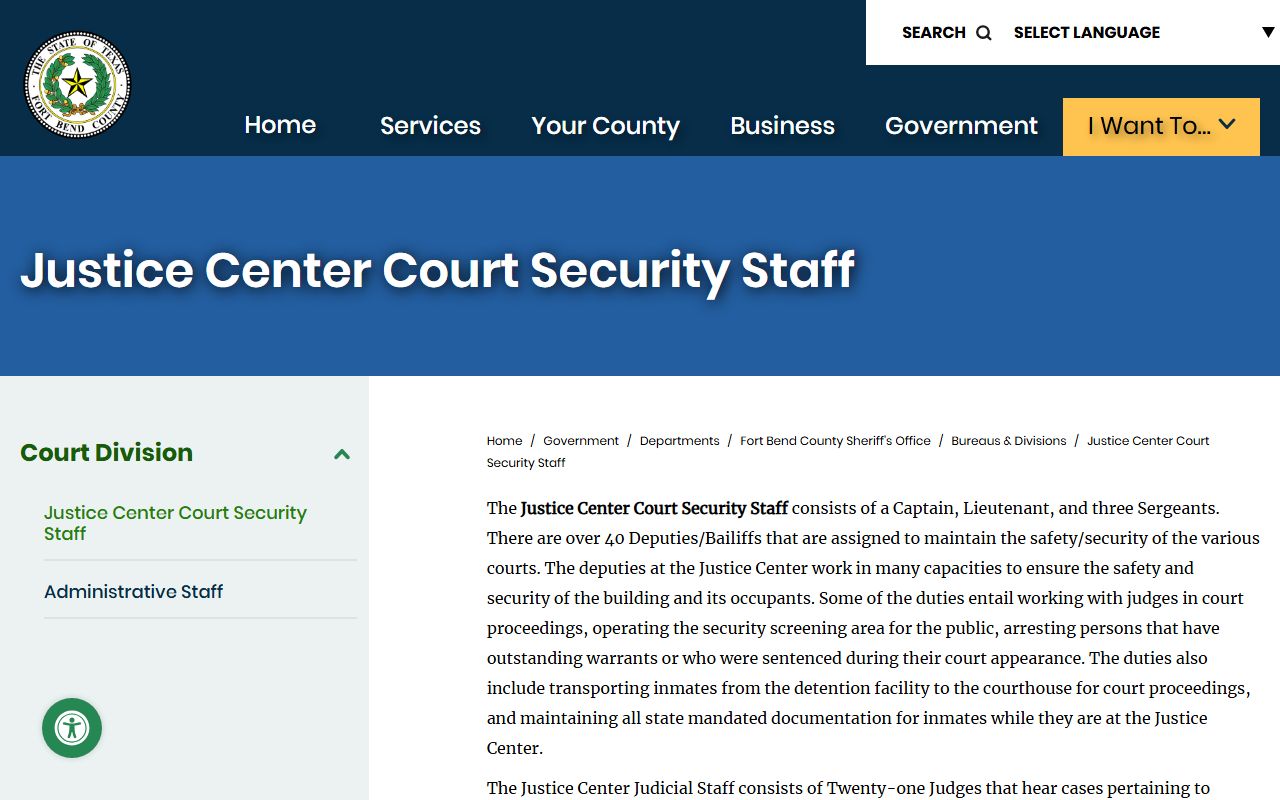
The Justice Center holds 17 courtrooms, a grand jury room, and a jury assembly room, with Sheriff's Court Security running the public screening at the entrance. The county is part of the regional Texas appellate system, so appeals from its district courts move to a Houston-area court of appeals.
The Justice Center court security page describes the building and screening.
Arrive early on docket and jury days, since screening at the entrance can slow things down.
The county grew into this court system over time. Court operations moved from the historic 1909 courthouse on Jackson Street, to the William B. Travis building that opened in 1989, to the Justice Center that opened in 2011. Each move added capacity as the county's population climbed. Today the district courts share the modern complex with the county courts at law, the clerks, and the District Attorney, which keeps most court business under one roof.
List of Fort Bend County District Courts
The county has ten numbered district courts and an Attorney General child support court. Most hear a general mix of felony, civil, and family cases, while the 387th is a designated family-law court. All sit at the Justice Center, 1422 Eugene Heimann Circle, Richmond.
| Court | Type | Address | Phone |
|---|---|---|---|
| 240th District Court | General jurisdiction | Justice Center, Richmond | 281-341-8600 |
| 268th District Court | General jurisdiction | Justice Center, Richmond | 281-341-8610 |
| 328th District Court | General jurisdiction | Justice Center, Richmond | 281-341-4406 |
| 387th District Court | Family law | Justice Center, Richmond | 281-238-3290 |
| 400th District Court | General jurisdiction | Justice Center, Richmond | 281-341-4422 |
| 434th District Court | General jurisdiction | Justice Center, Richmond | 281-633-7653 |
| 458th District Court | General jurisdiction | Justice Center, Richmond | 832-471-4905 |
| 501st District Court | General jurisdiction | Justice Center, Richmond | 832-471-4221 |
| 502nd District Court | General jurisdiction | Justice Center, Richmond | 832-471-4232 |
| 505th District Court | General jurisdiction | Justice Center, Richmond | 281-238-3244 |
| Child Support (IV-D) Court | Child support | Justice Center, Richmond | 281-344-3932 |
The District Courts page lists each court, judge, and contact.
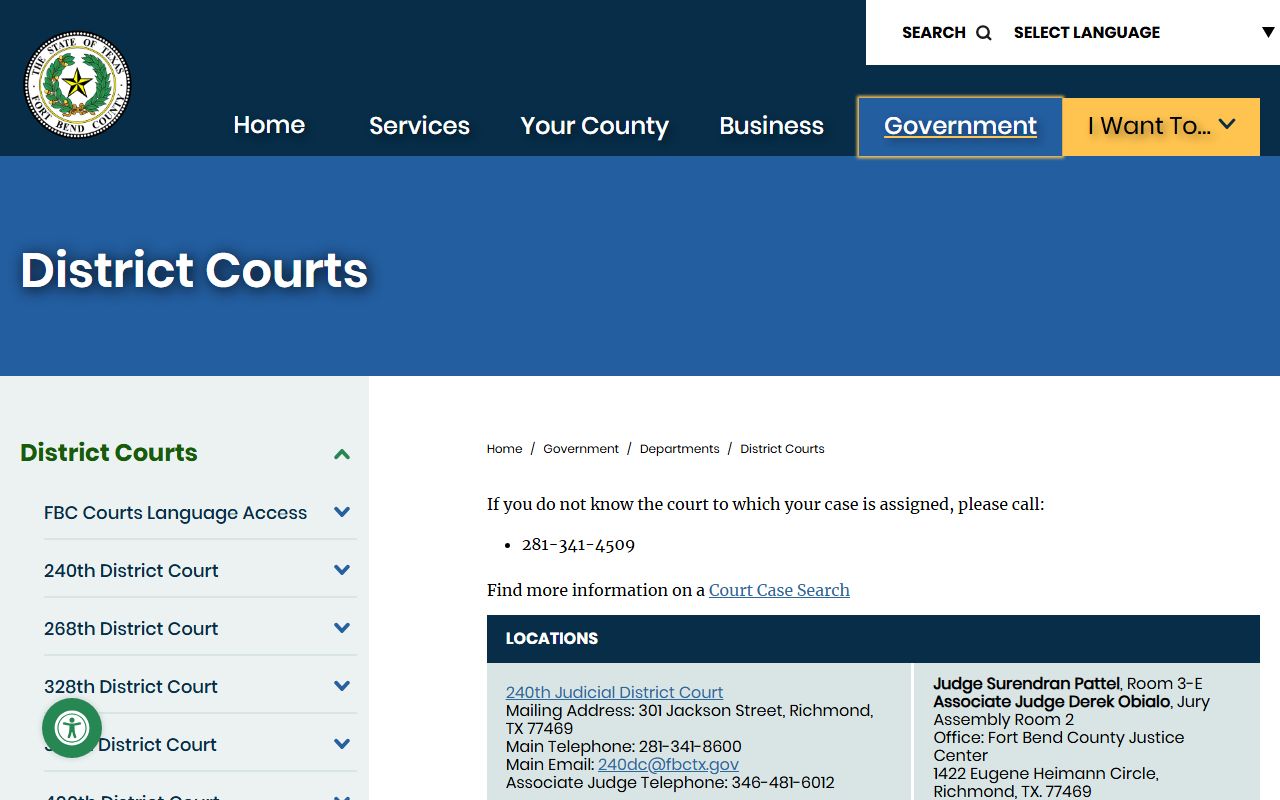
If you do not know which court holds a case, call 281-341-4509 for help with court assignment.
District Court vs. County Court vs. Justice Court
Texas spreads trial work by case type and size. District courts take the most serious and largest cases. County courts at law take misdemeanors, smaller civil cases, and probate. Justice of the peace courts take small claims and fine-only matters. The table compares the three levels.
| District Court | County Court at Law | Justice / JP Court | |
|---|---|---|---|
| Civil Matters | Larger civil suits | Civil under $325,000 | Small claims, lower value |
| Criminal Jurisdiction | Felonies | Class A and B misdemeanors | Fine-only Class C |
| Family Cases | Yes | Limited | No |
| Probate & Guardianship | No | Yes | No |
County courts at law also hear Class C appeals that come up from the justice of the peace and municipal courts.
The dollar and charge lines are the simplest way to tell the courts apart. Felonies and the largest civil suits belong to the district courts. Misdemeanors, civil cases under the county-court limit, probate, and guardianship belong to the county courts at law. Small claims, evictions, and fine-only traffic stay with the justice of the peace courts. When a case does not fit neatly, the case number and the assigned court on the docket settle which level holds it.
How a Case Moves Through the Fort Bend County System
Criminal and civil cases follow different paths, but both can end in an appeal. A felony begins with arrest and magistration, then moves into a district court by indictment. A civil suit begins with a petition and runs through discovery toward trial.
Criminal flow: Arrest › Magistrate / First Appearance › Indictment or Information › Arraignment › Pretrial › Trial › Sentencing › Appeal
Civil flow: Petition Filed › Answer › Discovery › Mediation › Trial › Judgment › Appeal
Appeals split at the top in Texas. Civil and juvenile appeals can reach the Supreme Court of Texas, while criminal appeals end at the Texas Court of Criminal Appeals.
Civil, Family, and Criminal Divisions
The district courts cover three broad kinds of work. Criminal dockets handle felony charges brought by the District Attorney. Family dockets, led by courts like the 387th, handle divorce, custody, enforcement, CPS cases, termination, adoption, name changes, and paternity. Civil dockets handle larger lawsuits over money, contracts, and property.
Several courts use associate judges to manage parts of the docket. The Attorney General child support court hears IV-D child support matters separately. The District Clerk keeps the files for all of these courts.
Family law is a large part of the work. The 387th District Court is a designated family court that hears divorce, custody disputes, enforcement, CPS cases, termination and adoption, name changes, domestic violence, and paternity. Family files often contain sensitive material about children and finances, so some documents are restricted even when the case is public. The courts provide no-cost language help for people who have trouble communicating in English.
Criminal felony work runs through the same courts. A felony case usually reaches a district court by grand jury indictment after arrest and magistration. The court then handles arraignment, pretrial matters, plea or trial, and sentencing. Specialty programs, such as the C.A.R.D. drug court tied to the district courts, aim to treat the cause of repeat offenses rather than only punish them. The District Clerk records every step in these cases, from the first filing to the final judgment.
Judicial District and Appeals
Each numbered court is its own judicial district court serving Fort Bend County. Texas does not use a single circuit number for the county the way some states do; instead, each district court carries its own number. Appeals from these courts go to a regional court of appeals in the Houston area, then potentially to one of the two Texas high courts depending on whether the case is civil or criminal.
This split top is unusual. The Supreme Court of Texas is the final court for civil and juvenile matters, while the Texas Court of Criminal Appeals is the final court for criminal matters. Both sit above the regional courts of appeals that first review Fort Bend County cases. For most people, the practical point is that a case does not simply end at the district court; there is a clear path upward if a party appeals.
County Courts at Law and Lower Courts
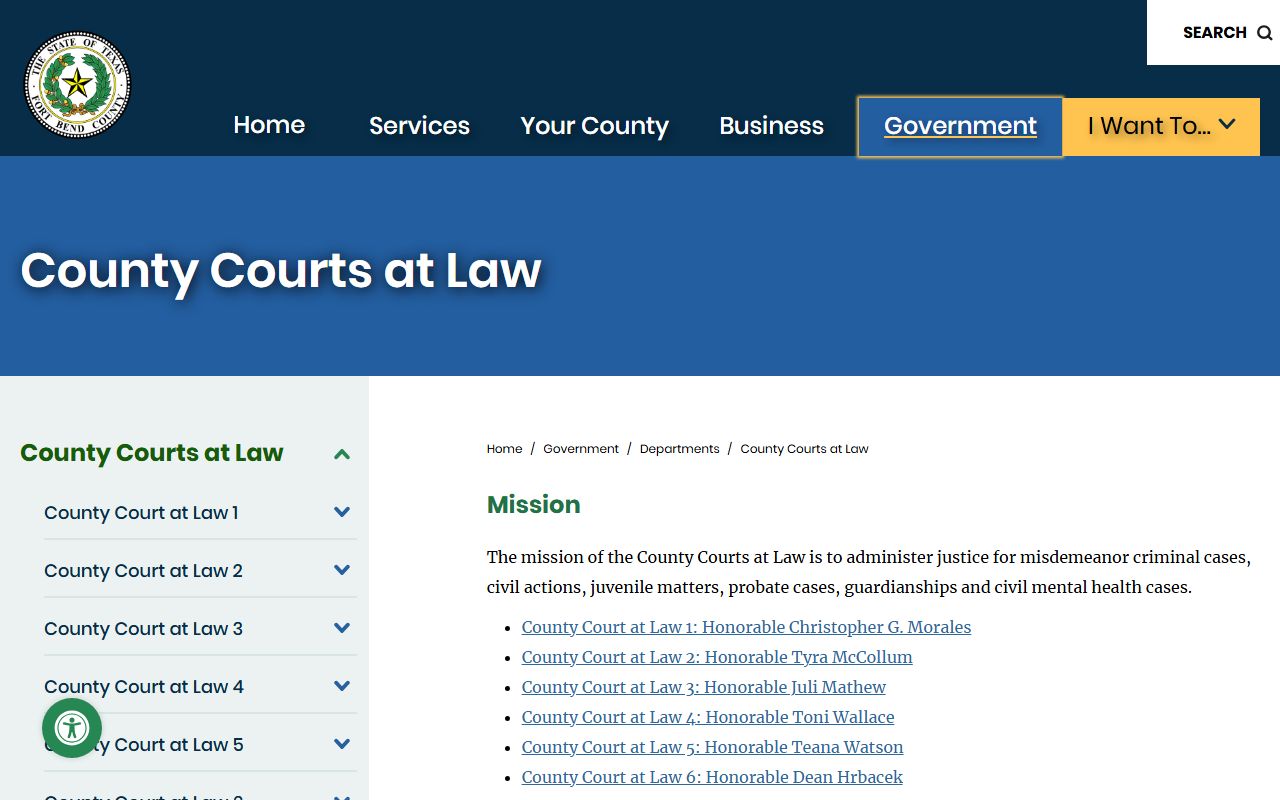
Below the district courts sit the county courts at law, the justice of the peace courts, and the municipal courts. The six county courts at law handle misdemeanors, probate, guardianship, and civil mental health matters. Justice of the peace courts handle small claims, evictions, and fine-only traffic by precinct. Municipal courts handle city ordinance and fine-only cases.
The County Courts at Law page lists the six statutory county courts.
A serious case can move up to a district court, while a fine-only matter stays in a lower court unless it is appealed.
The county courts at law also run several specialty programs. County Court at Law No. 1 oversees the county's only Misdemeanor Mental Health Court, No. 5 lists a Misdemeanor Treatment Court, No. 6 lists a DWI Court, No. 4 lists a C.O.R.E. Court, and No. 2 lists a Veteran's Court. These programs sit below the district courts but handle the day-to-day misdemeanor and treatment work that keeps cases from climbing the system.