
How to Search Fort Bend County Court Records
Fort Bend County runs its public case search through Tyler Public Access. The portal opens with one location set to Fort Bend. From there you choose a search type: Probate Case Records, Civil and Family Case Records, Criminal Case Records, or the Court Calendar. The same Tyler system is reached from the County Clerk Online Record Search page, so county misdemeanor, civil, and probate cases all run through it. The District Courts also link court case search. For docket and setting details, the Fort Bend County court dockets page goes deeper.
The county's official Fort Bend County homepage links to county records research, the jail inquiry, elected officials, and department pages. It is the simplest place to start.
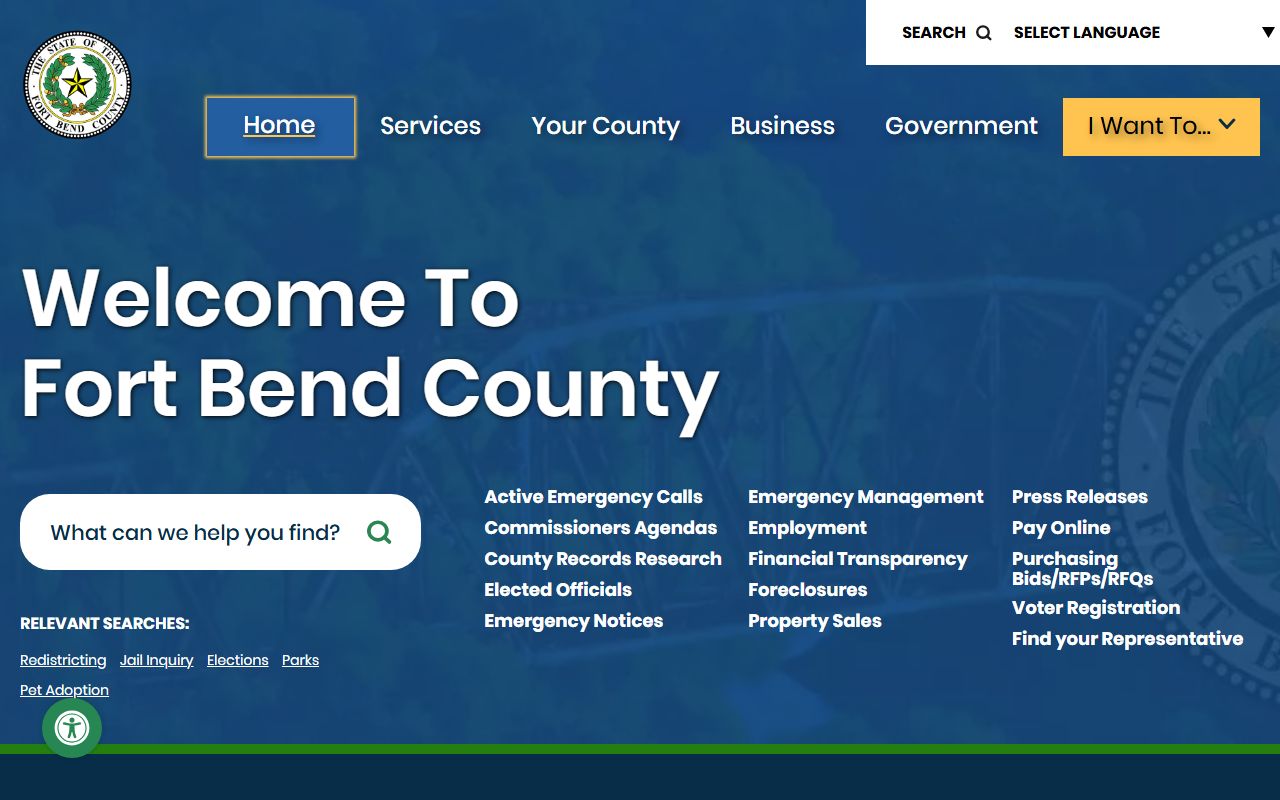
From the home page, the County Records Research link is the fastest route into the court search tools. Have the full name spelled the way it appears on the case, and a case number if you have one.
- Open the Fort Bend County homepage and select County Records Research.
- On the Online Record Search page, choose your record type, such as Civil Court, Misdemeanor, or Probate Court.
- The page sends you to the Tyler Public Access case records area.
- Pick the matching search category, then search by case number, party name, attorney, or the date the case was filed.
- Click the blue case number in the results to open the Register of Actions for party details, events and orders, and financial information.
The Tyler Public Access portal is the public case search for Fort Bend County courts.
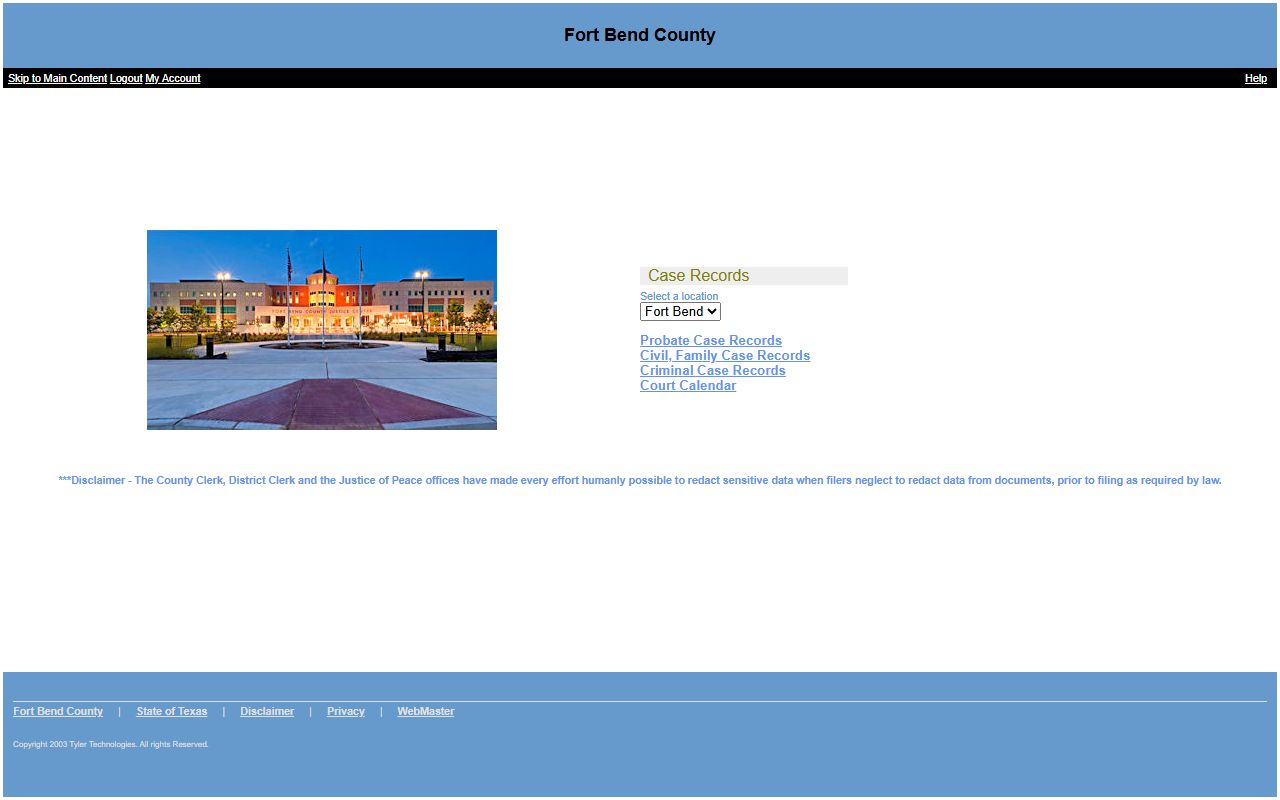
The landing page lists the four search categories. Each one opens its own search form. The fields below show what the Civil and Family search asks for.
| Field Label | Type | Required | Notes / Format |
|---|---|---|---|
| Case Number | Text | No | District and county case numbers often carry a year and court code. |
| Party Name | Text | No | Search by a person or business name. |
| Attorney | Text | No | Search by the attorney of record. |
| Date Filed | Date range | No | The date the case was filed, not a hearing date. |
| Search | Button | n/a | Runs the query and returns matching cases. |
The Fort Bend County Judicial System
Texas spreads trial work across several courts, and Fort Bend County uses all of them. District courts are the main general jurisdiction trial courts. They hear felony criminal cases, family law, larger civil suits, and juvenile matters. County courts at law handle misdemeanors, smaller civil cases, probate, guardianship, and civil mental health matters. Justice of the peace courts take small claims, evictions, and fine-only criminal and traffic cases. Municipal courts handle city ordinance and fine-only matters inside city limits.
Case flow: Justice of the Peace or Municipal Court › County Court at Law › District Court › Court of Appeals › Supreme Court of Texas or Court of Criminal Appeals
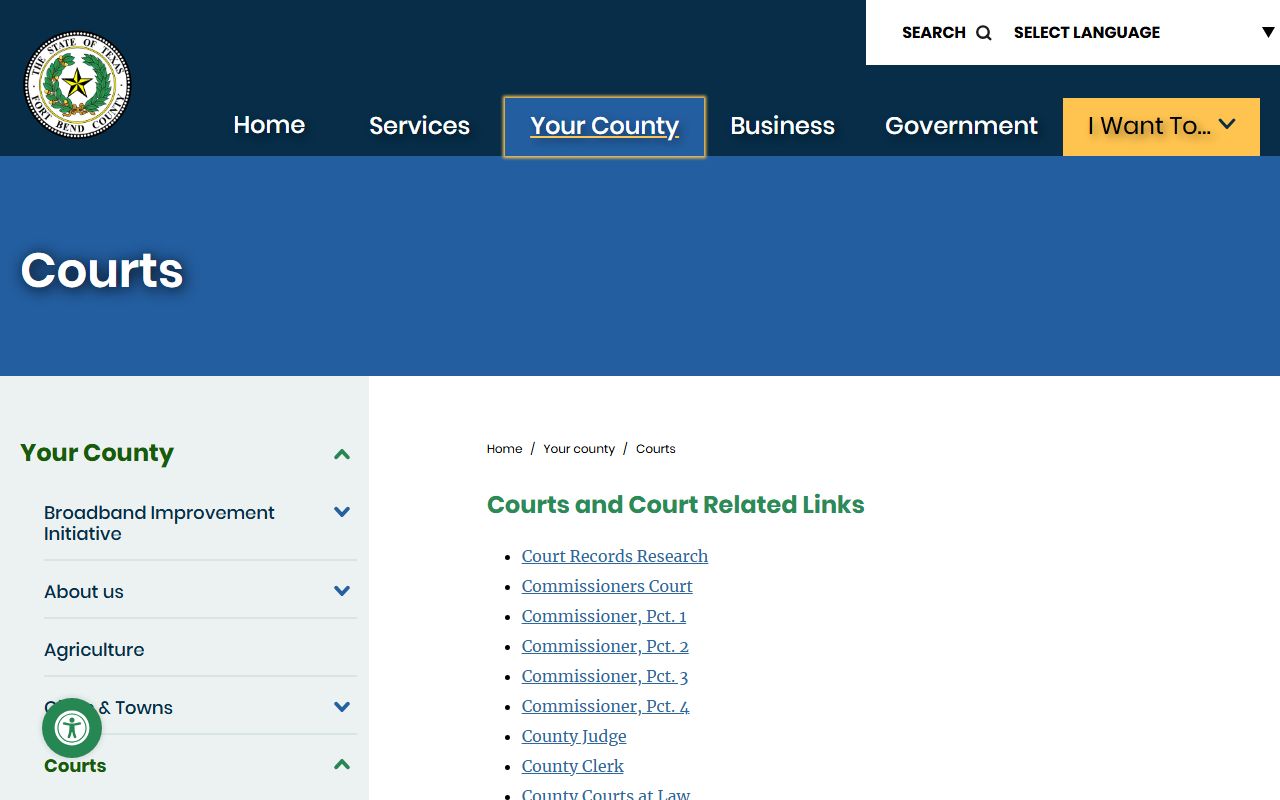
Appeals split in Texas. Civil and juvenile appeals can reach the Supreme Court of Texas. Criminal appeals end at the Texas Court of Criminal Appeals. Both sit above the regional courts of appeals that first review Fort Bend County cases. The county's county courts landing page ties these levels together with links to the District Courts, the County Courts at Law, and Commissioners Court.
The table sums up which Fort Bend County court hears which cases. For the full court list and judges, see the Fort Bend County District Court page.
| Court | Jurisdiction | Case Types |
|---|---|---|
| District Courts | General jurisdiction trial court | Felonies, family law, large civil, juvenile |
| County Courts at Law | Statutory county courts | Misdemeanors, probate, guardianship, civil mental health |
| Justice of the Peace | Limited jurisdiction | Small claims, evictions, fine-only criminal and traffic |
| Municipal Courts | City courts | Ordinance and fine-only matters in city limits |
Fort Bend County Courthouses
Court records and hearings center on Richmond. The Fort Bend County Justice Center is the working court complex. It holds the District Clerk, the County Clerk Courts Division, the District Attorney, the district courts, several county courts at law, the jury assembly room, and the law library. The historic County Courthouse a few blocks away keeps county administration and history offices. The Sheriff's Office and the county jail sit on Richmond Parkway.
The Justice Center facility page lists the courts and offices housed in the building, which opened July 5, 2011.
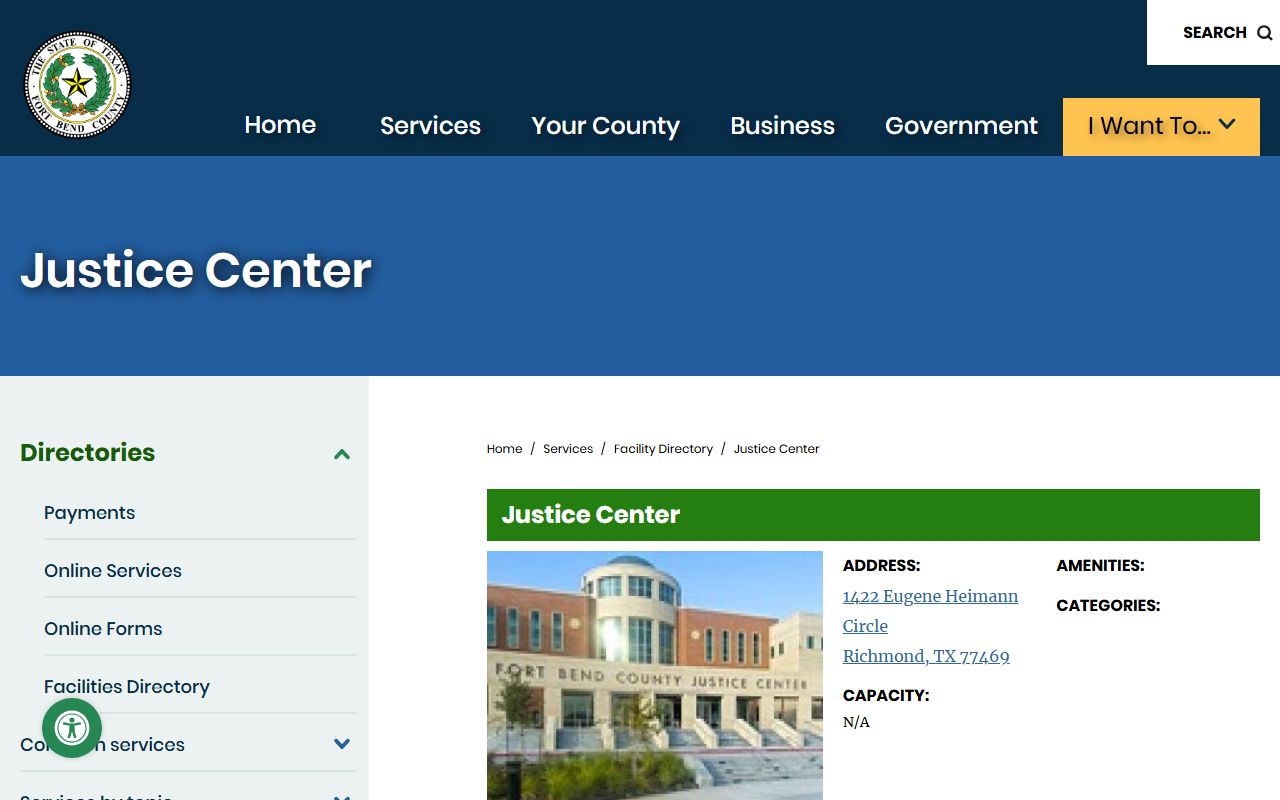
Most court-record, hearing, jury, and clerk visits go to the Justice Center, not the historic courthouse. The cards below give the main addresses.
Fort Bend County Justice Center
1422 Eugene Heimann Circle
Richmond, TX 77469
281-342-3411
Types of Court Records Available in Fort Bend County
Fort Bend County court records fall into a few broad groups. Which clerk holds the file depends on the court that handled it. Felony and district matters route to the District Clerk. Misdemeanor, probate, and many county-court matters route to the County Clerk. That split shapes every record search in the county.
- Criminal records: Felony files sit with the District Clerk; the County Clerk keeps Class A and B misdemeanors and Class C appeals from 1983 forward. See arrest and criminal records.
- Civil records: County-court civil cases under $325,000 plus condemnation and workers compensation matters run through the County Clerk; larger civil suits are district matters.
- Family and divorce records: Divorce, custody, support, and protective orders are district family matters; see marriage and divorce records.
- Probate records: Wills, guardianships, and trusts run through the county courts at law and the County Clerk from 1987 forward; see probate records.
- Traffic records: Fine-only citations sit with justice of the peace and municipal courts.
Juvenile, adoption, and civil mental health records are restricted by Texas law. They are not part of the open public case search.
What Fort Bend County Court Records Show
After a search, Fort Bend County opens the Register of Actions for the case. It is the main public view of a file. The county's own instructions say it shows party information, Events and Orders of the Court, and Financial Information. You reach it by clicking the blue case number in the result list. The fields below appear on most public case records.
| Field | What It Shows |
|---|---|
| Case Number | The file's identifier; Fort Bend examples include DCR district and CCR county criminal numbers. |
| Filing Date | The date the case was filed with the clerk. |
| Parties | Plaintiff and defendant, petitioner and respondent, or the State and a defendant. |
| Charges / Cause | The criminal charge or the civil claim driving the case. |
| Disposition | The outcome, such as dismissed, convicted, or judgment entered. |
| Sentence / Judgment | The final order, sentence, or money judgment. |
Events and Orders is the docket activity stream. It lists hearings, settings, filed motions, and signed orders. Financial Information can show court costs, fines, fees, and balances. Some legacy documents are still being moved into the county's Odyssey system and are not public during that project.
Public Access Laws for Fort Bend County Court Records
Texas keeps government records open by default. The Public Information Act, in Government Code Chapter 552, gives the public broad access unless a law makes information confidential. Courts are treated as a separate category, so court case files follow court rules and clerk processes rather than ordinary open-records requests. That is why a certified judgment comes from a clerk, not from a public information request.
Key Statutes:
Texas Government Code § 552.001 - states the policy that each person is entitled to full information about government affairs.
Texas Government Code § 552.021 - creates the public right to inspect and copy public information.
Texas Government Code § 552.0035 - treats judiciary records as a separate category handled by court rules.
Texas Government Code § 552.141 - keeps Social Security numbers on marriage applications confidential.
Anyone can search the public case index. For copies, you pay the clerk's fee. When a county department wants to withhold a record, it may have to ask the Texas Attorney General for a ruling. The full framework lives on the Fort Bend County public records page.
Records That Are Restricted or Confidential
Not every file is open. Juvenile matters, adoption files, and CPS termination cases are restricted by Texas law. Civil mental health commitment records and medical details stay private. Sealed records show little or nothing in the public portal. Birth and death certificates are not public record in Texas, and only Fort Bend County births and deaths appear through the county site for eligible requesters. Marriage application Social Security numbers are confidential.
To view a sealed file, a party usually files a motion, gives notice, and asks the court for an order. Expunction goes further than sealing. It directs agencies and clerks to remove or destroy eligible arrest and case records. A nondisclosure order does not destroy the record; it only limits who can see it. More detail sits on the arrest records page.
Specialty Courts in Fort Bend County
Fort Bend County runs several specialty court programs through its county courts at law. County Court at Law No. 1, under Judge Christopher G. Morales, oversees the county's only Misdemeanor Mental Health Court, built to cut repeat offenses among defendants with mental illness. County Court at Law No. 6 lists a DWI Court, and County Court at Law No. 2 lists a Veteran's Court. The district courts page also lists a Drug Court tied to the C.A.R.D. program.
These programs aim to treat the cause of repeat arrests instead of just jailing people. A defendant who qualifies may get supervision, treatment, and regular court check-ins. Eligibility and program rules are set by each court, so ask the assigned court before assuming a case fits a program.
Fort Bend County Sheriff and Jail
The Fort Bend County Sheriff's Office runs the county jail and the public jail inquiry. Sheriff Eric Fagan was re-elected as the county's 45th sheriff in November 2024 and took office in January 2021. The office reports more than 800 employees and 565 sworn peace officers serving nearly 900,000 residents over 885 square miles. The county jail is a U.S. Department of Justice certified detention center and was the first jail in Texas to earn PREA certification.
To find someone in custody, use the jail inquiry on the Fort Bend County inmate records page. To check for active warrants and capias entries, see warrant records. To confirm a release or set up custody alerts, the released inmates page and the jail population page cover the next steps.
Marriage, Divorce, and Probate Records
The County Clerk issues marriage licenses and keeps Fort Bend County marriage records. Divorce is a district family-law matter, so divorce decrees come from the District Clerk. Probate runs through the county courts at law, with the County Clerk as custodian. Start with marriage and divorce records for licenses and decrees, or probate records for wills and guardianships. A few probate terms come up often.
- Testator
- A person who makes a will.
- Executor
- The person named in a will to carry out its terms.
- Guardian
- A person a court appoints to care for someone who cannot manage their own affairs.
Fort Bend County Court Records Fees
Copy fees in Fort Bend County are set by the clerks and are easy to plan for. The County Clerk charges the same rate for most plain and certified copies. Certification adds a flat fee per document. You can pay in person, by mail, or by email request with the correct fee. The table lists the County Clerk copy fees.
| Item | Amount |
|---|---|
| Plain copy per page | $1.00 |
| Certified copy per page | $1.00 plus $5.00 certification per document |
| Certificate of Authentication | $5.00 |
| Non-certified electronic copy | $1.00 up to 10 pages, then $0.10 per page |
For full clerk fees and request steps, see the District Clerk and County Clerk pages.
How to Interpret Fort Bend County Court Records
Court records use shorthand that can confuse a first-time reader. A charge is only an accusation. A conviction is a court finding of guilt. A jail charge row is not the same as a final outcome. To know how a case ended, read the disposition and any judgment, not the booking charges.
Fort Bend case numbers carry codes. DCR points to a district criminal case. CCR points to a county criminal case. In the jail inquiry, the JUS field shows DIST or CTY for district or county jurisdiction. Level codes like F2, F3, and MA are common Texas shorthand for a second-degree felony, a third-degree felony, and a Class A misdemeanor. When in doubt, open the Register of Actions or call the clerk.
Accuracy and Record Limitations
Online records can lag behind the paper file. New filings take time to post. The County Clerk is moving older court documents into the Odyssey system through the Kofile project, and those legacy files are withheld during that work. Home-printed copies of official public records carry an "UNOFFICIAL DOCUMENT" watermark.
Note: Always confirm a name, date, or outcome with the District Clerk or County Clerk before relying on it for a legal, financial, or housing decision.
History of Fort Bend County Courts
Fort Bend County was created in 1837 from parts of Austin, Harris, and Brazoria counties, the same year the Republic of Texas incorporated Richmond. The first courthouse stood at the end of Morton Street and was bought in 1842 for $600. Construction on the courthouse now on Jackson Street began in 1908, and the building was dedicated in 1909.
The county's courthouse history page describes a Texas Renaissance design with a copper dome, clock faces, and a Lady Justice figure.
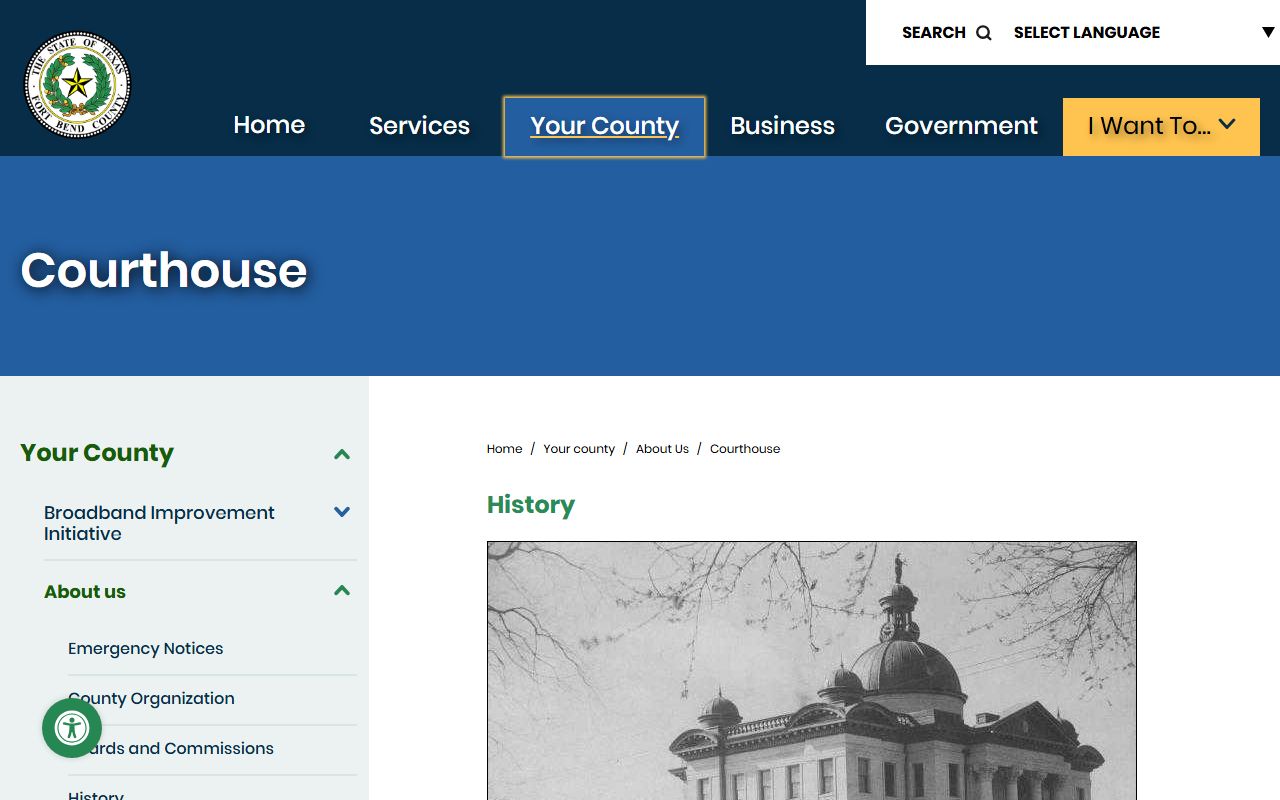
The 1909 courthouse was the first Fort Bend County building added to the National Register of Historic Places, in 1980. A seven-story William B. Travis building opened in 1989. The Justice Center followed in 2011 and brought the clerks, the District Attorney, and 17 courtrooms under one roof.
The historic courthouse facility page covers its 2012 to 2013 restoration.
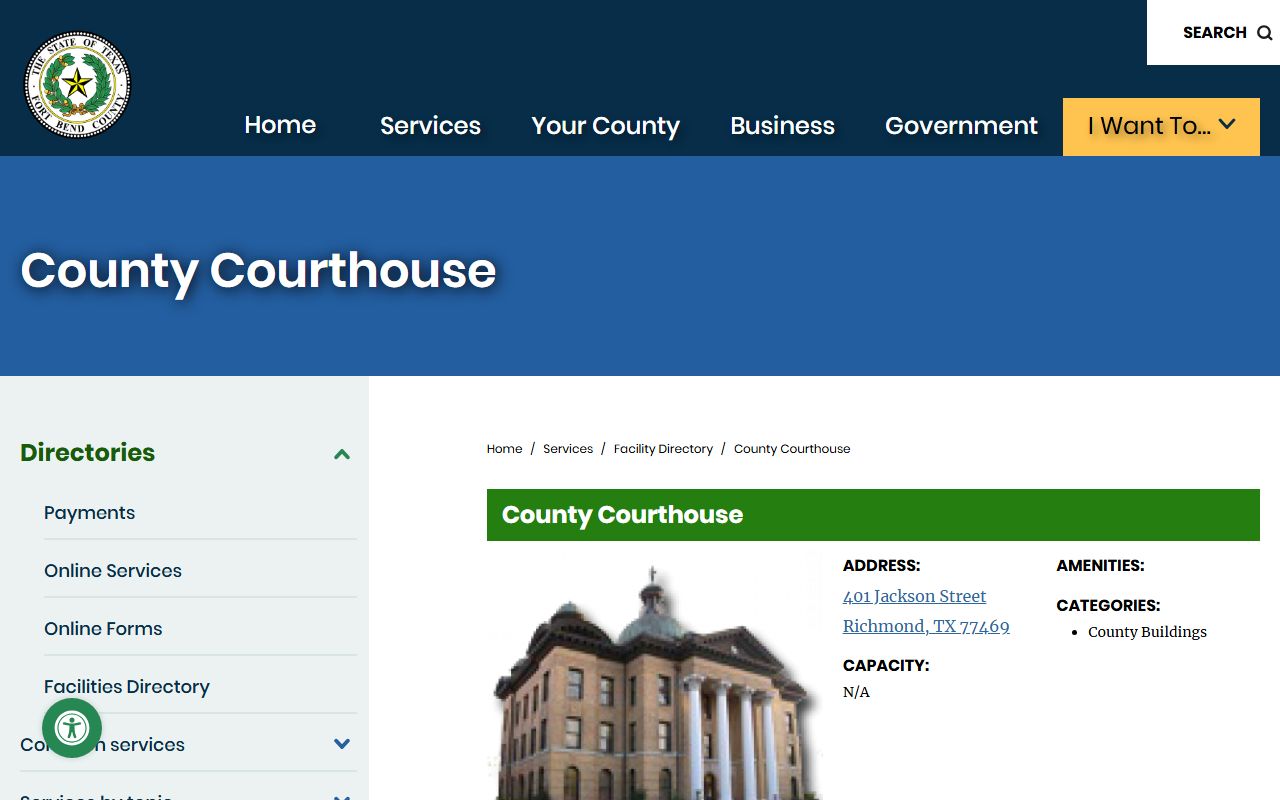
Today the county keeps both a modern court complex and the restored 1909 courthouse on the same Richmond campus.
Frequently Asked Questions
How do I search Fort Bend County court records?
Use the Tyler Public Access portal or the County Clerk Online Record Search page. Tyler lists Probate, Civil and Family, Criminal, and Court Calendar searches. You can search by case number, party name, attorney, or filing date. Click the blue case number to open the Register of Actions for the full case detail.
What is the difference between the District Clerk and the County Clerk?
The District Clerk handles district-court files such as felony, family, and large civil cases. The County Clerk keeps misdemeanor, probate, county-court civil, marriage, vital, and official public records. For a divorce decree, start with the District Clerk. For a marriage license or a deed, start with the County Clerk.
How do I find someone in the Fort Bend County Jail?
Use the Fort Bend County Jail Public Information Inquiry. Enter a last name, first name, or both; full or partial names work. Click the name to open the detail page with charges, bail, and jurisdiction. The inmate records page walks through each field.
More on the Fort Bend County Court Records FAQ page.